
If you live or work in an apartment building, shopping centre, office, or mixed-use development, your electricity may be supplied through an Embedded Network (EN).
This guide explains — in plain English — what an embedded network is, how it works, and what it means for you, from moving in and setting up power, through to billing, payments, and moving out.
What Is an Embedded Network?
An Embedded Network is a private electricity network that supplies power to multiple premises within a single site, such as:
- Apartment buildings
- Shopping centres
- Office or commercial buildings
- Retirement living or mixed-use developments
Instead of each tenancy being directly connected to the local electricity distributor, the site has one main connection, known as a Gate Meter.
The gate meter measures all electricity supplied to the site. Each apartment, shop, or tenancy then has its own individual meter (often called a sub-meter), which records only that tenancy’s electricity usage.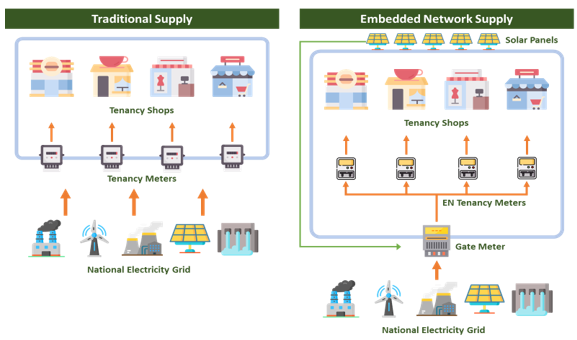
How Is This Different From a Standard Electricity Connection?
In a traditional setup:
- You choose an electricity retailer
- Electricity is supplied directly by the local distributor
- Your bill comes from a retailer
In an embedded network:
- The site owner purchases electricity in bulk
- Electricity is supplied through the site’s private network
- Your usage is still individually metered
- Billing is managed by an embedded network operator, such as Energy Intelligence
The important thing to know is that you still only pay for the electricity you use, just under a different supply arrangement.
Why Do Sites Use Embedded Networks?
Embedded networks are commonly used because they can offer:
- Bulk-purchased electricity
- More efficient energy management
- Support for sustainability initiatives
Many embedded networks form part of a broader sustainability plan, which may include:
- On-site solar generation
- Energy-efficient lighting and equipment
- Modern electrical infrastructure
- Smarter monitoring of energy usage
What Happens When I Move In?
Residential Tenants
When you move into a residential property within an embedded network, your power may be disconnected if the previous tenant has moved out.
For this reason, it’s important to sign up early and give plenty of notice before your move-in date. This allows us to reconnect your electricity before you move in, helping you avoid delays or arriving to a property without power.
Register your move-in here:
https://www.energyintel.com.au/move-in
What if my power is still off inside the apartment?
If your account has been set up and your supply has been reconnected, but you still don’t have power inside your tenancy, this is often due to:
- The internal switchboard being turned off
- A safety switch or circuit breaker being down
We’ve created a simple step-by-step guide to help you safely check this.
How to switch power on inside your tenancy:
https://www.energyintel.com.au/tenant-hub/mypower
Commercial & Retail Tenants
Commercial and retail tenants need to set up an electricity account when they take possession of the premises. Electricity accounts are not automatically transferred.
It’s just as important to let us know when you are moving out, so your account can be closed correctly and on time.
Notifying us directly helps avoid incorrect final bills, ongoing charges after vacating, and delays in closing accounts.
How Am I Billed?
Each tenancy in an embedded network has its own meter, so your bill is based on your actual electricity usage.
Your bill may include:
- Electricity consumption (kWh)
- Metering or service charges (where applicable)
- Government charges, rebates, or concessions (if eligible)
Billing frequency will depend on your site and tenancy arrangements.
Who Do I Pay?
In most embedded networks, you pay Energy Intelligence directly. Payment details are clearly shown at the bottom of your bill.
However, some sites operate differently. In certain locations, electricity charges may be recovered through outgoings or rent, or billing may be managed by the site owner or managing agent.
This is site-specific, and your bill or lease documentation will confirm which arrangement applies to you.
Moving Out – What You Need to Know
If you’re planning to move out, please let us know directly. We’re unable to backdate account closures, so it’s important not to rely on property managers, leasing agents, or new tenants to notify us on your behalf.
It’s also important to consider that you may still need power after vacating, for example for:
- Cleaning
- De-fit works
- Final inspections
- Leasing or handover access
Whether electricity is required during this period is usually covered in your lease agreement with the landlord, which we don’t have visibility over.
Disconnecting and reconnecting power unnecessarily can be costly and inconvenient, so it’s best to plan ahead, discuss timing with your landlord or agent, and let us know your preferred final date.
Questions, Support, or Concerns?
We’re here to help with:
- Understanding your bill
- Usage changes or spikes
- Moving in or moving out
- Metering questions
- Rebates and concessions
- Payment support or hardship options
Tenant FAQs:
https://www.energyintel.com.au/tenant-hub/tenant-faq-s
In Simple Terms…
An embedded network means:
- You’re supplied electricity through a shared, private network
- Your usage is individually metered
- Billing is managed centrally
- Many sites benefit from solar and sustainability initiatives
- Support is available when you need it
If you have questions at any stage — before, during, or after your tenancy — we’re here to help.