
Weather, Fuel Prices and Power Poles:
Why Your Electricity Bill Changes Every Year
Every year around July, electricity customers across Australia receive notifications advising that their electricity prices are changing.
While many people assume retailers simply decide to increase prices, the reality is far more complex. Electricity prices are influenced by everything from weather events and fuel costs to the condition of the nation's electricity networks and government policies.
So why do electricity rates change each year?
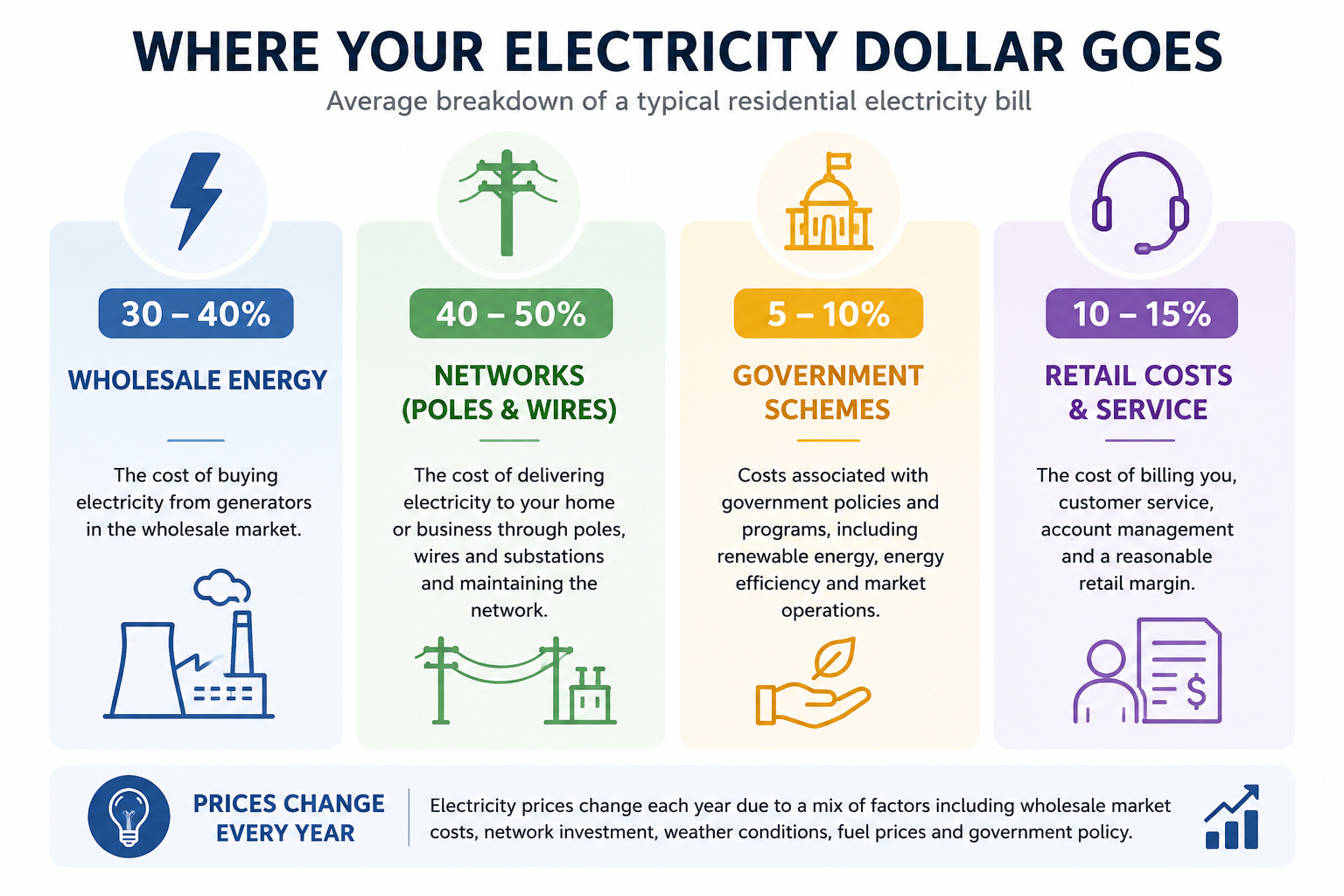
Electricity Is Bought and Sold Every Day
Before electricity reaches your home or business, retailers must purchase it from the wholesale electricity market.
The wholesale price of electricity changes constantly based on supply and demand. When demand increases or supply decreases, prices rise. When there is plenty of generation available, prices typically fall.
Several factors can influence wholesale electricity prices, including:
- Heatwaves driving increased air conditioning use.
- Cold weather increasing heating demand.
- Coal or gas power station outages.
- Fuel prices for coal and natural gas.
- The amount of renewable energy available from solar and wind farms.
- The availability of battery storage and hydro generation.
For example, during periods of extreme heat, electricity demand can increase significantly as homes and businesses rely more heavily on cooling systems. This can place additional pressure on the electricity grid and increase wholesale energy prices.
Weather Plays a Bigger Role Than Many People Realise
Weather affects both electricity demand and electricity supply.
- Hot weather increases air conditioning use.
- Cold weather increases heating demand.
- Cloudy days can reduce solar generation.
- Low wind conditions can reduce wind farm output.
- Drought conditions can impact hydroelectric generation.
- Storms can damage electricity infrastructure.
As a result, weather conditions can have a significant impact on electricity prices throughout the year.
The Cost of Maintaining the Network
Once electricity is generated, it must travel through poles, wires, substations and transformers before reaching customers.
Network businesses maintain and upgrade this infrastructure to ensure electricity remains reliable and safe.
Network costs can include:
- Replacing ageing equipment.
- Maintaining poles and wires.
- Upgrading substations and transformers.
- Supporting population growth and new developments.
- Improving reliability and resilience.
Network charges often make up a significant portion of a customer's electricity bill and are reviewed by regulators to ensure costs remain reasonable.
Government Policy Can Influence Prices
Government decisions can affect electricity prices both directly and indirectly.
- Energy bill relief and rebate programs.
- Renewable energy investment and incentives.
- Policies aimed at increasing electricity supply.
- Funding for transmission and network infrastructure.
- Changes to environmental and energy market schemes.
Governments may also introduce cost-of-living measures designed to reduce household energy costs. While these initiatives can affect the amount customers ultimately pay, the underlying electricity price remains largely driven by wholesale market costs, network charges and regulatory decisions.
Government policy settings can change over time and may be influenced by broader economic conditions, energy security objectives, emissions targets and cost-of-living priorities.
How the Australian Energy Regulator Reviews Prices
Each year, the Australian Energy Regulator (AER) reviews a range of costs before determining benchmark electricity prices known as the Default Market Offer (DMO).
The AER considers:
- Wholesale electricity costs.
- Network charges.
- Environmental and government scheme costs.
- Retail operating costs.
- Customer service and billing costs.
- A reasonable retail margin.
The purpose of this review is to ensure electricity prices remain fair, transparent and reflective of the actual cost of supplying electricity to customers.
The safety net: DMO and VDO
The Default Market Offer (DMO) and Victorian Default Offer (VDO) are regulated benchmark electricity prices set each year.
These benchmarks help ensure customers have a fair reference price and protect against excessive standing offers:
- DMO applies in NSW, South Australia, and South-East Queensland
- VDO applies in Victoria
They are updated annually based on real underlying costs — including wholesale electricity, network charges, environmental schemes, and retail operating costs.
When those costs rise, the DMO and VDO typically rise as well. This is why price changes often feel “system-wide” rather than isolated to individual retailers.
Why Prices Can Go Up or Down
Electricity prices are influenced by many factors, which means they do not always move in the same direction.
Prices may increase when:
- Wholesale electricity costs rise.
- Fuel prices increase.
- Electricity demand grows.
- Significant network investment is required.
Prices may decrease when:
- Wholesale electricity costs fall.
- More renewable generation enters the market.
- Network costs reduce.
- Government assistance programs offset costs.
The Bottom Line
Electricity prices are not determined by a single company or factor. They reflect the combined costs of generating electricity, transporting it through the network, maintaining reliability, and meeting regulatory and government requirements.
The biggest influences on annual electricity prices are typically wholesale market costs, network charges, weather conditions and government policies. Each year, regulators review these costs to help ensure consumers are charged fairly while maintaining a reliable and secure electricity supply.
The next time you receive a notice that your electricity rates are changing, it is likely the result of hundreds of factors occurring across Australia's energy system—not simply a decision made by your electricity retailer.
What Is Driving Electricity Pricing Changes in 2026–27?
| Cost Component | Direction | What Happened? |
|---|---|---|
| Wholesale Energy | ↓ Down | Lower electricity contract prices, reduced market volatility and increased output from wind and battery generation have reduced wholesale energy costs. |
| Environmental Costs | ↓ Down | Costs associated with renewable energy schemes have fallen compared with last year. |
| Retail Costs | ↓ Down / Stable | Retail operating costs have generally reduced or remained stable across most regions. |
| Network Costs | ↑ Up | The cost of maintaining and upgrading poles, wires, substations and transmission infrastructure has increased across many network areas. |
| Overall Benchmark Prices | ↓ Down | Reductions in wholesale, environmental and retail costs have generally outweighed increases in network costs, resulting in lower benchmark prices in most regions. |