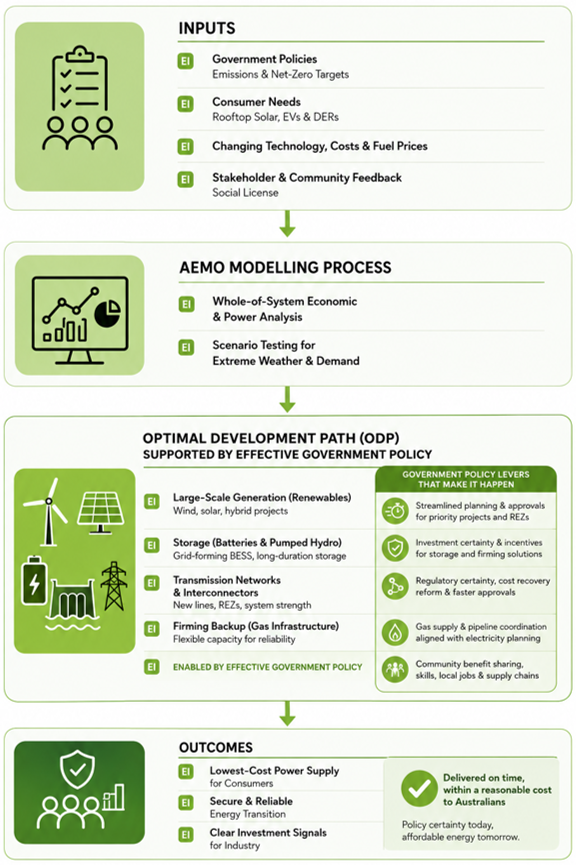
The acronym ISP refers to the Integrated System Plan. The term Integrated System is best understood through AEMO's definition:
“The Integrated System Plan (ISP) is a whole-of-system roadmap that guides the efficient development and investment of Australia's National Electricity Market (NEM) over a horizon of at least 20–25 years.”
The basic purpose of the ISP is to guide the NEM's transition to a reliable, secure and lower-cost electricity system based increasingly on renewable energy, firming and new technologies through to 2050.
So why use such a provocative way to introduce the topic? Why compare the ISP to The Da Vinci Code?
In the simplest terms, the ISP is an ambitious roadmap that can look far easier to draw than to deliver. The destination may be clear, but getting from point A to point Z requires many interconnected pieces to move in the right order, at the right time and at a reasonable cost.
Political debate, competing interests, social pressures and differing views about the pace and nature of the transition can all disrupt that process.
Before exploring those complications, it is worth briefly understanding what the ISP is designed to do.
What Is the Integrated System Plan?
The ISP is developed by AEMO every two years, allowing the roadmap to be updated as technology, demand, investment, costs and the wider NEM evolve.
The Core Features of the ISP Include:
- The Optimal Development Path (ODP) – the pathway identified as the least-cost way to transition from the traditional fossil-fuel-based NEM to a renewable system supported by firming.
- Actionable Projects – the priority network and infrastructure projects that need to progress to maintain a reliable and affordable NEM.
- Biennial Updates – AEMO's two-yearly review of the outlook and pathway.
- A Long-Term Outlook – a 20–25 year view of Australia's evolving electricity system through to 2050.
As with any long-term project, the ISP also depends on a number of strategies working together.
AEMO's Key Transition Strategies Include:
- Renewable Energy Zones (REZs) – development of new wind and solar generation in areas suited to renewable production.
- Boosting Storage and Firming – growth in grid-scale BESS, pumped hydro and other firming capability, including gas where required.
- Consumer Energy Resources (CER) – recognising the growing role of household solar, batteries and flexible consumer demand.
ISP Challenges and Complications – “The Da Vinci Code”
The aim of the ISP is clear enough. On paper, it is a logical pathway for the NEM and for Australian consumers.
The difficulty is that the electricity system is not being transformed in isolation. It sits inside a complex environment of community expectations, politics, planning, investment, supply chains, technology and changing patterns of demand.
These competing pressures create the real challenge: not necessarily deciding where Australia needs to go but getting all the pieces to move together quickly enough to keep the system reliable and affordable.
1. The “Social Licence” Bottleneck
- Community Resistance – opposition from local communities can delay or prevent grid-scale infrastructure and large REZ developments, including projects in areas such as the Gippsland food bowl.
- Planning Overhauls and Diversions – energy planning has traditionally focused heavily on finding the lowest-cost option. Increasingly, community support and broader social considerations must also be incorporated because projects facing strong opposition can be delayed for years and become substantially more expensive.
2. Transmission Cost Blowouts and Delays
- Network Cost Variations and Repricing – the cost of HV infrastructure has risen with labour, raw materials, specialist equipment, insurance, licensing and permitting costs.
- Generation Build Delays – large-scale renewable projects, particularly wind, can face lengthy regulatory, planning and approval processes. If projects take years to move from concept to construction, the timing of the transition becomes increasingly difficult to manage.
3. Disjointed Infrastructure Coordination
- Premature Coal-Fired Generation Retirements – retiring existing generation before replacement renewable generation, storage and network infrastructure is ready creates a reliability risk and can increase costs for consumers. A delayed transition creates the possibility of supply gaps and, in the worst case, reliability events.
- The Gas-Grid Problem – as coal generation is replaced by wind and solar, gas may be required to provide firming when renewable output is low. This means electricity planning cannot be separated entirely from gas supply, infrastructure and transport constraints.
4. More Homes Producing and Storing Their Own Power
- Rapid Growth – more households are installing solar panels and batteries, often faster than large-scale generation and storage projects are being built.
- The Challenge – the system needs better ways to coordinate these distributed energy resources so they can support the grid when and where they are needed.
- Virtual Power Plants – aggregating household batteries and solar can create a resource that behaves like a larger power station. However, the technology, market rules and incentives needed to fully realise these benefits are still developing, putting some of the projected system savings at risk.
5. Not Enough Equipment or Skilled Workers
- Global Competition – Australia is competing internationally for transformers, turbines, batteries and other critical electricity infrastructure.
- Skills Shortage – the transition requires large numbers of engineers, electricians and other skilled workers to build new generation, storage and thousands of kilometres of transmission. Supply is currently constrained.
6. Keeping the Grid Stable
- A Changing Electricity System – traditional coal and gas generators provide inertia through their large spinning machines, helping maintain system stability.
- A New Challenge – as synchronous generators retire, the system needs new technologies, including grid-forming batteries and other equipment, to provide equivalent stability and system services.
- The Challenge Ahead – operating a grid with very high levels of wind and solar is technically more complex and requires investment in new forms of system support.
7. The “Data Centre” Demand Spike
- The Boom in Artificial Intelligence and Technology – rapid growth in AI and digital infrastructure has materially increased electricity demand expectations.
- Data centres are projected to grow from around 2% of total grid demand today to roughly 12% by 2050, creating a new pressure on the transition timeline.
- At the same time, their scale and characteristics mean they could become part of the solution rather than simply another demand problem.
What Is Working and Going to Plan So Far?
- More Australians Are Choosing Solar and Batteries – household solar and battery uptake is stronger than earlier expectations, with AEMO now expecting around 35 GW of household battery capacity by 2050, up from its earlier estimate of 27 GW.
- Large Batteries Are Growing Quickly – more large-scale battery projects are being developed and connected, providing additional storage and support when renewable generation is low.
- Strong Industry and Community Involvement – AEMO engaged with communities, consumers and industry during development of the plan, with almost 2,000 people and organisations providing input. The quality and effectiveness of that engagement remain an important part of successful delivery.
From Challenges to Delivery
The common thread through these challenges is that the ISP does not suffer from a lack of ambition or a lack of identified technologies. The harder problem is execution.
Generation, transmission, storage, system strength, consumers, communities, investment and new demand are interdependent; delaying one part can increase the cost or risk of another.
This is also where the energy transition can become more interesting.
Data centres and other large new loads are not simply additional demand. Properly planned, they can help underpin new renewable generation, storage and network investment, while technologies such as grid-forming BESS, Virtual Power Plants, smart demand management and advanced forecasting can make the existing system work harder and smarter.
The Role of Government Policy
If the ISP is the roadmap, government policy needs to be the road-building program.
AEMO can identify the most efficient pathway, but it cannot deliver the physical infrastructure on its own. Governments, regulators, networks, investors and consumers must create the conditions that turn the roadmap into projects on the ground.
The fundamental policy question should therefore shift from:
“What should Australia's future electricity system look like?”
to:
“What policies will allow us to build it on time, at the lowest reasonable cost, while protecting Australian consumers?”
This requires a change in how governments approach the energy transition.
1. Give Investors Long-Term Policy Certainty
The energy transition requires billions of dollars of private investment. Investors will commit that capital only if they can have reasonable confidence that the policy and regulatory settings will remain stable.
Government should establish clear, long-term settings for renewable generation, storage, transmission, firming and new sources of electricity demand.
The objective should not be to continually change the rules to favour individual technologies. Instead, governments should define the outcomes required — reliability, affordability, emissions reduction and system security — and allow investors and technology providers to determine the most efficient way to achieve them.
2. Make Build Time and Project Delivery a Core Government Performance Measure
One of the greatest risks to the ISP is not knowing what needs to be built. It is knowing what needs to be built but taking too long to build it.
Planning, environmental approvals, connection processes, land access and community consultation can add years to major projects.
Government should establish clear timeframes and coordinated approval pathways for projects identified as strategically important to the ISP.
This does not mean removing environmental or community protections. It means making the process clearer, faster and more coordinated, so projects do not become trapped between multiple departments, regulators and approval processes.
3. Reward Communities That Host the Transition
Social licence cannot simply be treated as an obstacle to overcome.
If Australia needs thousands of kilometres of new transmission lines, REZs, wind farms, solar farms and batteries, the communities hosting this infrastructure should see a meaningful and transparent benefit.
Government policy should therefore create clear and consistent benefit-sharing arrangements for affected communities and landowners.
The principle is simple:
If Australia benefits from the infrastructure, the communities hosting it should benefit too.
This can help turn community opposition from a barrier into a more constructive partnership.
Creating a sense of community contribution to the issue, whilst directly benefiting from that contribution, should be a positive step towards progress.
A great live example of this is the concept of community renewable hubs. The concept of community-funded and owned BESS deployments could make whole-of-community municipal areas renewable by using residual local residential and commercial PV generation as a community benefit instead of free power for retailers going back into the grid.
With solar feed-in now looking more like solar donation back to the NEM, why can't communities harness this generation to be supplied at a low cost to residents who do not have the capacity, for one reason or another, to be renewable?
This is a concept that is currently being trialled in some similar form or another in a few scattered municipalities around the country.
Even with such schemes and noble contributions to the pathway forwards, there will always be one in the crowd, so to speak. Expectation that unanimous agreement and uptake is unrealistic, but perhaps this is the most sensible pathway to a renewable future.
4. Stop Treating Every New Project as a Stand-Alone Project
The ISP should increasingly be delivered as an integrated energy system rather than as a collection of individual projects.
For example, a new wind farm should not necessarily be viewed simply as “another wind farm”. It could be developed as a complete energy package incorporating:
- Wind generation
- Grid-forming BESS — standalone and coupled with generation assets
- Transmission capacity
- System-strength capability
- Demand-response capability
- Potential industrial or data-centre demand
- Other technologies that improve reliability and reduce network costs
Government policy should encourage this type of integrated project development rather than forcing each component through separate planning and investment processes.
This becomes increasingly important as the electricity system moves away from traditional synchronous generation and requires more coordinated system-strength and stability solutions.
5. Make New Demand Part of the Solution
Australia's rapidly growing data-centre industry is a good example of why energy policy needs to evolve.
Data centres are often presented as a major new electricity problem. They certainly create additional demand. However, large, reliable demand can also create, attract and drive investment.
Rather than simply asking how the electricity required by data centres will be supplied, governments should also ask how that new demand can help build the electricity system Australia needs anyway.
Stakeholders should be involved in these conversations, with appropriate regulatory boundaries and potentially legislated contributions for high-demand projects.
Policy could encourage large new loads to support investment in renewable generation and storage through long-term power purchase arrangements, co-investment, flexible demand, new renewable projects and dedicated firming solutions.
In this way, the data-centre boom could become a catalyst for the energy transition rather than simply another burden on the grid.
However, DO NOT GIVE AWAY THE FARM! Australian assets must remain Australia's.
Investment and ownership can be decoupled by effective policy formulation and strategic negotiation with overseas investors.
The Dan Andrews model of investment for progress does not and will not work. Learn from such mistakes and refine our policy guidelines and investment boundaries whilst maintaining an attractive proposition for potential investors into the NEM and WEM.
6. Let Technology Compete to Reduce the Cost
Government should be careful not to decide too early which technology will “win”.
The objective should be to create a framework where technologies compete to provide the required energy and system services at the lowest whole-of-system cost.
This could include:
- Grid-forming batteries
- Battery storage integrated with renewable generation
- Pumped hydro
- Virtual Power Plants
- Demand response
- Advanced forecasting and energy management
- Flexible industrial and data-centre loads
- New forms of system-strength technology
- Emerging storage and generation technologies
The policy framework should reward what a technology delivers to the electricity system, rather than simply what technology it is.
This allows the market to discover solutions that may not yet be obvious in today's planning models.
7. Make the Consumer the Final Test
Ultimately, Australians will pay for the transition — through electricity bills, taxation or the broader cost of government support.
That means every major policy decision should pass a simple test:
Does this policy help deliver a reliable, secure electricity system at the lowest reasonable long-term cost to consumers?
This does not necessarily mean choosing the cheapest project today.
A project that costs slightly more but can be built quickly, provides system stability, reduces future network investment and avoids costly delays may be cheaper for consumers over its lifetime.
The measure should therefore be whole-of-system cost, rather than simply the upfront cost of an individual project.
The Government's Role: Set the Rules, Then Get Out of the Way
Perhaps the biggest policy change required is a change in mindset.
Government does not need to build every component of Australia's future electricity system, nor predict exactly which technology will dominate.
Its role is to set the destination, establish stable rules, remove unnecessary obstacles, protect consumers, reward communities and create investment certainty — then allow the private sector and technology to compete to find the best way there.
Breaking the Code
This brings us back to the Da Vinci Code.
The ISP is not really a mystery. AEMO has identified the broad pathway. The difficult part is getting the individual pieces — renewable generation, storage, transmission, gas, consumers, communities, technology, investment and new demand — to fit together at the right time and at an acceptable cost.
The opportunity now is to move from a policy environment that largely manages the transition to one that actively enables and accelerates it.
If governments can provide policy certainty, speed up approvals, improve community participation, encourage integrated projects, reward technological innovation and make new demand such as data centres part of the investment solution, Australia has a much better chance of making the ISP deliverable.
And perhaps that is the key to breaking the code:
Don't spend more trying to solve the same problem. Change the rules so that investment, innovation and new demand help solve it for us.
The prize is not simply meeting Australia's renewable energy targets. It is delivering a reliable, secure and modern electricity system on time, while ensuring the benefits of the transition are broadly shared and Australian consumers are not asked to carry unnecessary costs.
The real challenge is therefore not whether Australia knows where it wants to go. AEMO, through the ISP, has mapped out the broad destination.
The challenge is how we get there faster, at the lowest practical whole-of-system cost, while maintaining reliability and bringing communities, consumers and investors along.
We have most of the pieces we need. We need to agree on the long-term direction, put the pieces in the right places and give the market enough certainty to build them.
That is the real Da Vinci Code.
Perhaps the answer is simpler than it first appears: build the right infrastructure, attract the right investment, embrace the right technology and make new demand — including Australia's data-centre boom — part of the solution rather than treating it as another problem.
The ISP Does Not Need to Be Rewritten. It Needs to Be Unlocked.