
Australia is entering a new phase of electricity demand.
The rapid growth of cloud computing, artificial intelligence, data storage and digital services is driving significant investment in data centres, with some proposed facilities requiring hundreds of megawatts of electricity.
For the energy sector, this represents more than simply another source of electricity demand.
Data centres are large, concentrated and often relatively continuous electricity users. Their growth has implications for generation, renewable energy, batteries, transmission and distribution networks, connection standards and ultimately the way electricity system costs are allocated.
The Australian Energy Market Operator (AEMO) and the Australian Energy Market Commission (AEMC) are now treating data centres as an increasingly important component of Australia's future electricity system. AEMO has identified data centres as one of the fastest-growing sources of electricity demand in both the National Electricity Market (NEM) and Western Australia's Wholesale Electricity Market (WEM). AEMO
For investors and developers considering a data centre project, understanding these changes early is becoming increasingly important.
Key Takeaways
- Data centre electricity demand is growing rapidly. AEMO forecasts NEM data centre consumption could reach approximately 12 TWh by 2030 and around 34 TWh by 2050.
- Where a data centre connects matters. A project may have access to sufficient generation within the NEM while the local transmission or distribution network still requires significant investment.
- Renewables and firming are becoming part of the policy framework. The Australian Government and AEMC are increasingly considering how new data centres should support clean and firm electricity supply.
- BESS may become an important part of the energy strategy. Batteries can provide firming, resilience and potentially greater flexibility in how a data centre interacts with the electricity system.
- Data centres can help absorb daytime solar generation. Their relatively continuous demand can provide load during periods of strong solar output, although their location and network connection remain important.
- Network cost allocation is becoming a major regulatory issue. The AEMC is examining how network costs should be recovered as large new loads, including data centres, connect to the system.
- Technical connection standards are changing. New requirements are being developed for large inverter-based loads, including data centres.
- Water is another infrastructure consideration. Cooling requirements can create significant water demand depending on the facility's design, technology and location.
- The regulatory framework is still developing. Energy planning should therefore be considered early in the development process rather than treated as a final-stage connection exercise.
Data centres are becoming a significant source of electricity demand
AEMO's forecasting now treats data centres as a distinct category of electricity demand rather than simply grouping them with other commercial customers.
In FY2025, data centres across the NEM were estimated to consume around 4 TWh of electricity, approximately 2.2% of total grid demand.
Under AEMO's Step Change scenario, data centre electricity consumption is forecast to grow by approximately 25% per year in the near term, reaching around 12 TWh by FY2030, equivalent to approximately 6% of NEM grid-supplied electricity.
Longer term, consumption is forecast to reach around 34 TWh by FY2050, or approximately 12% of NEM grid-supplied electricity.
These are forecasts rather than guaranteed outcomes, and the actual pace of development will depend on factors including project economics, access to electricity, planning approvals, network capacity and the availability of suitable sites.
However, the scale of the potential demand is significant enough that it is now being incorporated directly into national electricity system planning.
AEMO's 2026 Integrated System Plan also considers higher and lower demand outcomes associated with data centres and other large industrial loads.
Why are data centres different from traditional electricity demand?
One of the defining characteristics of a data centre is the requirement for highly reliable electricity.
A traditional commercial or industrial customer may have some ability to reduce electricity consumption during periods of high system demand or electricity market stress.
A data centre supporting critical digital infrastructure generally has much less ability to simply switch off.
However, this does not necessarily mean that every component of a data centre's electricity demand has to operate in exactly the same way at all times.
Some computing workloads may have greater flexibility around when they are processed. Battery storage can also allow a facility to manage its electricity demand without necessarily interrupting critical operations.
This distinction is becoming increasingly relevant to regulators.
In its August 2026 advice to Energy Ministers, the AEMC recommended that data centres should bring clean and firm energy into the system, operate flexibly where possible, connect efficiently and appropriately contribute to the costs they impose on the electricity system.
The AEMC's advice reflects a broader question now facing the energy market:
How should very large new electricity loads connect to the NEM while supporting reliability, affordability and the transition to renewable generation?
The "duck curve" and the opportunity for data centre demand
Australia's increasing penetration of solar generation has changed the shape of electricity demand throughout the day.
During periods of strong solar generation, particularly around the middle of the day, the amount of electricity required from the grid can fall significantly.
This phenomenon is commonly referred to as the "duck curve".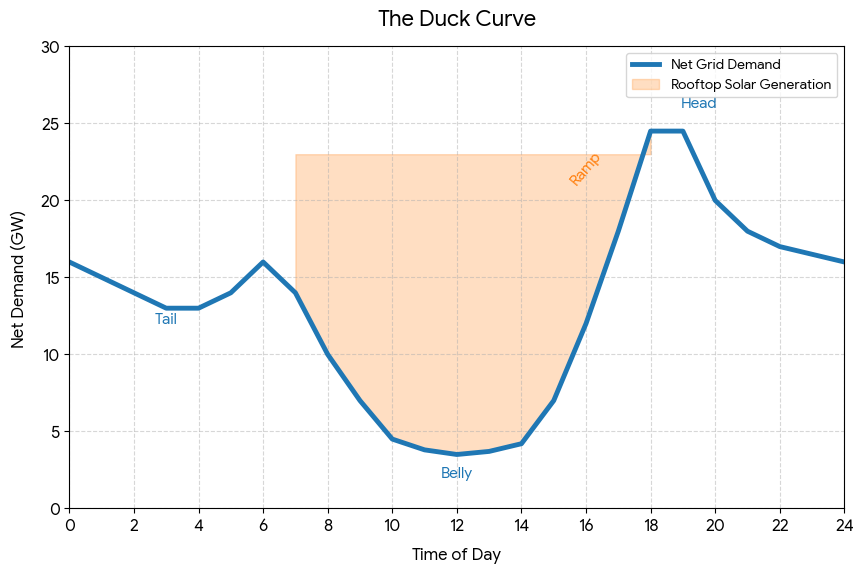
The challenge is that solar generation can be strongest at precisely the time when conventional grid demand is relatively low.
As solar generation falls later in the afternoon, electricity demand from the grid can then increase rapidly.
This creates an interesting characteristic of data centre demand.
Data centres generally operate continuously, meaning their electricity consumption occurs during the middle of the day when solar generation is strong as well as during the evening when solar output falls.
In simple terms, a large data centre can provide a substantial amount of underlying electricity demand during periods when Australia has significant solar generation available.
That does not mean data centres automatically solve the duck curve.
Their demand still has to be supplied, and the location of the facility remains critical.
However, from a system perspective, additional daytime demand can help absorb some of the electricity that would otherwise contribute to very low or negative wholesale prices.
This creates an important distinction between the volume of electricity demand and the timing of electricity demand.
The regulatory question is increasingly becoming:
Where, when and under what conditions should large new electricity demand connect?
BESS and data centres
Battery Energy Storage Systems (BESS) are likely to become an increasingly important part of the discussion.
A battery located alongside a data centre could potentially perform several functions.
During periods of strong solar generation, the data centre could continue operating while the BESS charges.
Later, when electricity prices or network demand increase, the battery could discharge and reduce the amount of electricity being drawn from the grid.
The BESS could also provide additional resilience and help manage short-duration changes in the facility's load.
This creates a potential combination of:
Renewable generation + BESS + data centre load
rather than treating the data centre simply as another large electricity customer.
AEMO's broader system planning places increasing importance on storage and other firming resources as renewable generation increases. AEMO reported that 67.3 GW of projects were progressing through the NEM connection process in the first quarter of 2026, with batteries accounting for around half of that pipeline.
For a data centre developer, therefore, BESS may increasingly be considered as part of the overall energy strategy rather than simply as a backup power system.
The value of a BESS will, however, depend on factors such as its size, operating strategy, connection point, network constraints, electricity market arrangements and the technical requirements of the facility.
Could data centres become flexible electricity loads?
This is one of the more interesting areas of the emerging energy discussion.
Not every computing workload necessarily needs to occur at exactly the same time.
Where technically possible, some workloads may be scheduled around electricity availability, network conditions or other operational requirements.
This is different from simply asking a data centre to shut down.
The potential future model could involve managed flexibility.
A data centre could maintain critical operations while adjusting non-critical workloads, using batteries or other energy management systems to reduce its impact on the electricity network during selected periods.
AEMO has identified flexible electricity use as increasingly valuable as the energy system changes, noting that flexible energy use can reduce or defer investment and smooth extreme price outcomes.
The AEMC has similarly recommended that data centres operate flexibly where possible.
For the industry, this could mean that future data centre connection arrangements increasingly consider not only:
"How much electricity does the facility require?" but also "How does the facility use that electricity?"
The distribution network matters too
Much of the discussion around data centres focuses on transmission networks and very large hyperscale facilities.
However, the distribution network is also important.
Electricity networks are not simply one large interconnected system with unlimited capacity.
A data centre may have access to sufficient generation somewhere within the NEM while the local network around the proposed connection does not have sufficient capacity to deliver that electricity.
This is particularly important where multiple large developments are concentrated in the same geographic area.
A number of data centres connecting in the same region can create significant requirements for:
- substations;
- transformers;
- high-voltage connections;
- distribution infrastructure;
- protection systems; and
- additional network capacity.
The result is an important distinction:
The NEM may have enough electricity overall, while the local network may still require significant investment.
This is why site selection and energy infrastructure planning can become critical considerations for data centre developers.
Who pays for the network investment?
This is likely to remain one of the most important regulatory questions.
Large data centres can require substantial investment in network infrastructure.
The question is how much of that investment should be paid by the individual project and how much should be recovered across a broader group of electricity customers.
The AEMC has specifically identified this issue in its work on electricity network regulation.
Its current review is considering how network regulation should evolve as the electricity system changes, including the way networks recover costs and respond to new sources of demand.
The AEMC has also highlighted concerns about the potential for existing consumers to subsidise infrastructure required primarily to accommodate very large new loads.
This does not necessarily mean that a data centre should pay for every network investment associated with its connection.
Some network investment may provide benefits to multiple customers or form part of broader network development.
The regulatory challenge is determining:
- which investment is genuinely incremental;
- which investment provides broader system benefits;
- how network capacity should be allocated; and
- how the resulting costs should be recovered.
What does this mean for other electricity customers?
The answer is not necessarily straightforward.
If a large new load requires substantial network augmentation and other customers contribute to the cost, there is potential for data-centre-driven infrastructure investment to increase costs across a broader customer base.
This is one reason the AEMC's recent advice has emphasised that data centres should appropriately contribute to the costs they impose on the electricity system.
At the same time, additional electricity demand is not necessarily negative for the electricity market.
Large new customers can provide investment certainty for new generation and storage.
Data centre operators may also enter into long-term electricity contracts or Power Purchase Agreements (PPAs), which can support investment in renewable generation.
The challenge is therefore one of balance.
New demand should be able to connect, but the costs and benefits associated with that connection need to be appropriately allocated.
Renewable energy and firming are becoming part of the policy framework
The policy environment is now moving beyond simply asking whether a data centre has access to electricity.
The AEMC's August 2026 advice to Energy Ministers recommends that data centres bring clean and firm energy into the electricity system, operate flexibly where possible and connect in a way that avoids unnecessary costs for other consumers.
The Australian Government is also developing requirements around renewable energy and firming for new large-scale data centres.
The practical implementation of these requirements will be important.
For investors, renewable energy procurement can no longer necessarily be considered a separate sustainability exercise undertaken after the electricity connection has been established.
Instead, renewable generation, firming, storage, electricity procurement and network capacity may increasingly need to be considered together.
Technical connection standards are also changing
The scale and electrical characteristics of modern data centres are creating another regulatory issue.
Data centres use significant amounts of power-electronic equipment, including uninterruptible power supplies, power conversion equipment and other inverter-based technologies.
This can affect how a facility behaves during disturbances on the electricity system.
In 2026, the AEMC progressed changes to technical standards for large inverter-based loads, following an AEMO rule change request.
The work is intended to establish clearer and more consistent requirements for large loads and improve the ability of the power system to remain secure as significant inverter-based demand connects.
The objective is not to prevent data centres from connecting.
Rather, the intention is to establish clearer and more consistent technical requirements so that very large loads can connect without creating unacceptable risks for the broader power system.
As data centres become larger, these technical requirements will form another important part of the development process.
Water is another infrastructure consideration
Electricity is not the only infrastructure issue associated with data centres.
Cooling systems can require significant volumes of water, although the amount varies considerably depending on the facility's design, climate and cooling technology.
This creates another infrastructure consideration for developers.
A data centre is not isolated from the other infrastructure around it.
Its development may interact with:
- electricity networks;
- water infrastructure;
- telecommunications;
- roads;
- land availability; and
- local planning requirements.
The choice of cooling technology can therefore influence both energy and water requirements.
This is another reason why infrastructure planning needs to occur early in the development process rather than being considered independently by separate project teams.
What can Australia learn from overseas?
Australia is not the first market to experience rapid growth in data centre electricity demand.
Ireland, the United Kingdom and parts of the United States have already been dealing with similar questions around grid capacity, connection queues, renewable energy supply and who should pay for infrastructure associated with large new electricity loads.
Ireland
Ireland provides one of the more relevant international examples.
Rapid data centre growth has placed significant pressure on the country's electricity system, particularly around Dublin.
In response, regulators and policymakers have introduced measures aimed at ensuring new data centre connections consider available network capacity and the broader impact on the electricity system.
Ireland has also increasingly linked data centre development with renewable generation and storage.
The lesson for Australia is not that the Irish model should simply be copied.
Rather, it demonstrates that data centre policy quickly becomes energy policy when the concentration of new electricity demand becomes large enough.
United Kingdom
The United Kingdom is taking a different approach to another part of the problem.
Ofgem is considering stronger financial commitment requirements for projects seeking grid connections, including measures designed to reduce speculative applications and improve the use of scarce network capacity.
The issue is familiar to Australia: network connection queues can contain projects that may not ultimately proceed, while viable projects can be waiting for access to infrastructure.
The UK experience highlights the importance of ensuring that connection processes provide sufficient certainty for both developers and network operators.
United States
The United States provides another perspective.
Rapid data centre development in markets such as Virginia and Texas has generated significant debate around network investment, electricity prices and the allocation of costs associated with large new loads.
Some jurisdictions are examining arrangements that require data centres to take greater responsibility for dedicated infrastructure and system costs.
Again, the US electricity market is structured differently from the NEM, so the approaches cannot simply be transferred to Australia.
China
China provides another interesting example of how governments are approaching the rapid growth of data centre and artificial intelligence infrastructure.
Rather than treating data centres simply as new electricity customers, China has increasingly incorporated computing infrastructure into broader national energy and infrastructure planning.
Its "East-to-West" computing strategy is designed to move some computing capacity towards regions where land, energy and renewable generation are more readily available, while connecting those facilities through a national computing network.
This approach recognises an important characteristic of data centre demand: the location of computing workloads does not always have to be the same as the location of the end user.
Where workloads can be moved or scheduled, computing capacity can potentially be located in areas with greater electricity availability, renewable generation or lower network constraints.
China has also placed a strong emphasis on renewable electricity consumption within its national data centre hubs. China's National Data Administration has stated that national hub-node data centres are expected to increase their green electricity consumption above an 80% level, with government policy focused on improving the coordination between computing demand and electricity supply.
This is particularly relevant to Australia because it demonstrates a different way of thinking about the relationship between data centres and the electricity system.
Rather than building a large data centre first and then determining how the electricity system can accommodate it, the approach considers computing demand, generation, network capacity and renewable energy together.
Direct renewable electricity supply
China has also introduced a policy framework for green electricity direct connection.
Under this model, renewable generators such as solar and wind projects can supply electricity directly to an individual electricity user through a dedicated connection, with arrangements available both for projects connected to the public grid and for certain off-grid configurations.
The policy specifically refers to principles including source-load matching, clear physical responsibility boundaries and improving the ability to consume renewable energy close to where it is generated.
In 2026, China expanded the framework to allow multi-user green electricity direct connection arrangements.
While Australia's electricity market and regulatory framework are very different, the concept is worth watching.
For a large electricity user such as a data centre, it raises the possibility of considering the project as part of an integrated energy system:
Renewable generation + BESS + network connection + data centre load
rather than treating each component as a separate project.
This is particularly relevant as Australia considers how new data centres should bring additional renewable generation and firming capacity into the electricity system.
Computing demand as a flexible resource
China's approach also highlights the potential importance of the location and flexibility of computing workloads.
Not all computing tasks require the same latency or need to be processed at the same physical location. Some workloads can potentially be scheduled or distributed between different data centres.
In principle, this creates the possibility of matching some computing activity with the availability of electricity.
For example, workloads could potentially be directed towards regions experiencing strong renewable generation or greater available network capacity.
This concept is still developing and should not be interpreted as meaning that critical data centre operations can simply be moved whenever electricity prices change.
However, it illustrates an important opportunity for the future:
Data centres may not only be large electricity loads; some computing demand could potentially become a flexible component of the electricity system.
What can Australia learn?
Australia does not need to replicate China's approach. The NEM has a different market structure, network configuration, regulatory framework and geographic profile.
However, China's experience demonstrates the value of considering energy infrastructure and data centre infrastructure together.
For Australia, this could mean considering questions such as:
- Should large data centres be encouraged to locate where renewable generation and network capacity are available?
- Can new renewable generation and BESS be developed alongside major data centre projects?
- Can electricity infrastructure be planned around the expected growth of computing demand?
- Can flexible computing workloads help absorb periods of high renewable generation?
- Could new connection models allow large users to participate more directly in renewable energy projects?
These questions are increasingly relevant as Australia considers how to accommodate rapidly growing data centre demand without placing unnecessary pressure on the broader electricity system.
The international experience suggests that the most effective approach may not be simply to ask how the electricity grid can accommodate data centres.
It may instead be to consider how data centres, renewable generation, storage and electricity networks can be planned together.
However, the international experience demonstrates that the same fundamental questions are emerging across electricity markets:
- How much new infrastructure is required?
- Who should pay for it?
- How much renewable generation and firming should accompany new demand?
- How can large loads contribute flexibility to the electricity system?
These are questions Australia is now addressing through its own regulatory framework.
What should investors and developers consider?
For investors considering a new data centre, energy requirements are becoming an increasingly important part of the development equation.
The electricity connection is only one part of the picture.
A project may need to consider:
- available network capacity;
- connection requirements and timeframes;
- transmission and distribution constraints;
- renewable electricity requirements;
- firming capacity;
- BESS opportunities;
- electricity procurement;
- Power Purchase Agreements;
- demand management;
- metering;
- embedded network arrangements where relevant;
- technical connection standards;
- network augmentation costs;
- water availability and cooling requirements; and
- the regulatory requirements that may apply over the life of the project.
Importantly, the rules are continuing to evolve.
AEMO is incorporating data centre growth into its electricity demand forecasts and system planning, while the AEMC is considering changes to connection standards, network regulation and the treatment of large new loads.
For a project that may take several years to develop and operate for decades, energy decisions made during the early planning stages can therefore have a significant impact on its future operating costs and regulatory position.
How Energy Intelligence can assist
For investors and developers considering a data centre project, energy planning should form part of the development strategy from the outset.
Energy Intelligence works across the energy requirements of major commercial and infrastructure projects, including energy procurement, energy management, metering, embedded networks, renewable energy and regulatory requirements.
Our role is to provide independent energy advice and help clients navigate the interaction between their project and the evolving energy market.
For a data centre development, this can include considering:
Energy Strategy
Assessing the project's electricity requirements and developing an appropriate procurement and energy management strategy.
Network and Connection Considerations
Understanding available capacity, connection requirements and potential network constraints.
Renewable Energy and BESS
Assessing renewable energy procurement, on-site generation, storage and firming opportunities.
Regulatory Requirements
Monitoring the evolving NEM, AEMO and AEMC requirements and identifying how changes may affect the project.
Metering and Energy Management
Developing appropriate metering and ongoing energy management arrangements to support the facility once operational.
The regulatory environment surrounding data centres is moving quickly.
For investors and developers, having an energy specialist involved early can help identify opportunities, constraints and potential costs before they become project issues.
If you are considering a data centre development or investment, speak with Energy Intelligence about the energy requirements of your project.
The bigger picture
The growth of data centres represents a significant change in the profile of electricity demand in Australia.
It is not simply a question of whether the NEM has enough electricity to supply new facilities.
The broader questions are how that demand is connected, where it is located, when electricity is consumed, how renewable generation and firming are integrated, how network investment is funded and how the costs and benefits are shared across the electricity system.
AEMO's forecasts indicate that data centres could become a material component of Australia's electricity demand.
The AEMC's recent advice demonstrates that regulators are now considering how these facilities should interact with the electricity system.
For the data centre industry, the direction of travel is becoming clearer:
Large new electricity demand will need to be planned alongside the energy system rather than simply connected to it.
For investors, that makes energy strategy an increasingly important part of data centre development — and an area where specialist energy advice can add value from the very beginning.